
| Economics A comprehensive e-learning course library comprising 16 courses on various topics in understanding Economics. | |
 | |
| For
information about our other e-learning solutions see Course
Catalog | |
| |||||
| Overview: A comprehensive e-learning course library comprising 16 courses on various topics in understanding Economics. This e-learning course on 'Economics' introduces the key concepts in micro- and macroeconomics. The course introduces some of the important concepts such as elasticity and efficiency, which enable analysts to differentiate among various companies on an individual level, and to determine their attractiveness for an investor. The course also compares and contrasts the different market structures in which firms operate, that are monopoly, perfect competition, monopolistic competition and oligopoly. The course then introduces the macroeconomic concepts that have an impact on all firms in the same environment. The course explains the business cycle, the impact of changes on price levels and profitability, and how an economy's aggregate supply and aggregate demand are determined. Finally the course discusses the monetary sector of an economy. It examines the functions of money, how it is created, and the role of the central bank. The course also describes the concept of inflation and circumstances that lead to inflation. Finally,
the course explores the goals and implications of fiscal and monetary policy with
the help of main models of macroeconomic theory Keynesian, classical, and monetarist. Target Audience
Course Level and Number of Courses Intermediate level. Library of 16 Courses Instructional
Method To purchase this course online, visit: Link For purchase,contact us at | |
Economics A. Microeconomics 1. Elasticity This
course focuses on one of the microeconomic concepts-Elasticity-and how firms are
affected by this concept. One of the main concepts related to the equilibrium
between demand and supply is elasticity, which measures the dependency between
demand and supply and the impact of changes in either on the equilibrium price
level. 2. Efficiency and Equity This
course focuses on the concept of efficiency and equity and reviews the concepts
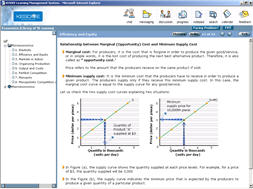
related to efficient allocation of resources. The course explains the marginal
cost and marginal benefit for calculating the efficient quantity of any product.
It shows the relationship between the marginal cost and minimum supply cost. It
also delves into other important aspects like consumer surplus, producer surplus
and the relationship between them with equilibrium. The course describes how the
allocation of efficient resources takes place. Finally, the course 3. Markets in Action The
course explains the impact of price ceiling on equilibrium in short-run and long-run
supply and demand and on the black market. It also describes the effects of minimum
wage and provides details about the impact of tax incidence on demand, supply,
and equilibrium. It explains the impact of subsidies and quotas and the impact
of market for illegal goods on demand, supply, and equilibrium. 4. Organizing Production This course introduces the concept of economic profit and describes how the firms measure costs and profits. The course gives an insight of various challenges faced by the firms and how they coordinate production in such cases. Various markets and the level of competitiveness of an industry are discussed in the course. The course also describes the advantages of operating efficiently in the market. 5. Output and Costs This
course provides an understanding on one of the major concepts of "optimal
output" given its cost and revenue functions. This course also focuses on
how output and costs decision affects the efficiency of a firm. 6. Perfect Competition This course is a part of the syllabus prescribed by CFA Institute for the Level I exam. This course aims to provide an understanding of the perfect competition market structure. The characteristics of the market profit maximising conditions of the firm and other factors causing changes to the short-run and long run equilibrium. 7. Monopoly The course provides an understanding of the characteristics of monopoly and factors allowing monopoly to arise. The course provides and overview of price-setting strategies of monopoly. The course also focuses on the relationship between price, Marginal Revenue (MR) and elasticity with respect to monopoly, price discrimination, and also the distribution of consumer and producer surplus in monopoly situation. In addition to these, it explains the potential gains from monopoly and the regulation of a natural monopoly. 8. Monopolistic Competition and Oligopoly This
course aims to develop an understanding on two types of market structure Monopolistic
B. Macroeconomics 9. Demand and Supply in Factor Markets It explains the demand and supply that exists in the factor market with emphasis on labor as a factor of production. It also explores the capital market and explains the different kinds of capital that exists. Apart from labor and capital this course also stresses upon the two different types of natural resources renewable and non-renewable. Lastly it distinguishes between economic rent and opportunity costs in factor incomes. 10. Monitoring Cycles, Jobs, and the Price Level It explains the business cycle, the different kinds of employment and the meaning of unemployment. This course also highlights the labor market indicators, aggregate hours, real wage rate and their relation to GDP. It talks about the consumer price index, its calculation procedure and its biases. 11.
Aggregate Supply and Aggregate Demand It talks about aggregate demand and aggregate supply, the reasons for their fluctuations. The course explains the short-run and long-run macroeconomic equilibrium and expounds the viewpoints of the different macroeconomic schools of thought. 12.
Money, Banks, and the Federal Reserve This
course provides an understanding of the functions of money and how it is created,
highlighting the special role of the central bank within an economy. 13.
Money, Interest, Real GDP, and the Price Level The course focuses on an important macroeconomic section-monetary sector of the economy. It examines the concept of creation of money and its functions. The course describes the role of central bank within an economy. It explains the impact of interest rates on demand and supply of money and also elaborates the quantity theory of money. 14. Inflation Inflation is a global phenomenon that impacts everyone. This course deals with the phenomenon of inflation. It explains what inflation is and how it is measured. It examines the causes of inflation and theories that explain these causes. The course also looks at the various costs to the economy associated with inflation. 15.
Fiscal Policy 16.
Monetary Policy | |
| For
more information about our e-learning products and services visit us at www.kesdee.com |
|
|
 Home
Home